
 PhotoAlbum
 Google Map
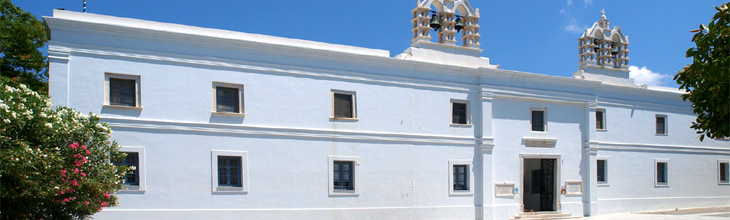
Panagia (Virgin Mary) Ekatontapyliani in Paros
Panagia Ekatontapyliani or Katapoliani is the sacred jewel of Paros, one of the most important early Christian monuments of Greece.
It is located within the village of Parikia, on the east side and near the harbour, and has a remarkable and important history that begins from the Byzantine period.
The temple owes its name to its 100 gates, 99 of which are visible and the hundredth will be revealed when the Greeks will recapture the Constantinople, as it is said.
The Katapoliani, probably derived from the term "Katapola" meaning "in town", probably indicating the location of the ancient city of Paros.
Its construction, according to tradition, must be started in the 4th century by St Helena, the mother of Saint Constantine, who made a vow that if she found the Holy Cross, she would build a church at the location of a small temple she had found when she stopped in Paros throughout her journey to find the cross. Then, after she carried out the purpose of her trip, she fulfilled her promise.
In another version, the church was built by the Constantine the Great, with a mandate that received from his mother because she did not manage to fulfil her vow.
In the beginning, it had a form of a wooden-roofed in the shape of a cross basilica church, which was probably destroyed by fire. At the period of Iustinianos, it was rebuilt and shaped with domes and cupola. According to tradition, the church is the work of the student of the master builder who built Agia Sophia in Istanbul.
select summary1 from bnhotels where id = and lang_id=2